
Low-Friction Kitchen: Small-Space Tweaks That Make Cooking More Enjoyable
Once people learn that I am a professional recipe developer and nutritionist with a focus on meal planning, they often assume that I have a sprawling kitchen and walk-in pantry. In reality, I live in a small house with a small kitchen, and I don’t even have a dishwasher!
That’s right, I have developed over a thousand recipes and have hand-washed every single measuring cup, bowl, and pan along the way. Over the years, I’ve had to find ways to make my limited space work to reduce the friction of cooking and keep the joy in making and eating. Here is how I make it happen.
How to Corral Kitchen Chaos (and Create an Easy Access Pantry)
The first order of business was figuring out where to keep the food. Since my kitchen cupboards were already full of dishes and equipment, I had to use a divide and conquer approach to the pantry, claiming spaces in other parts of the house.
The Front Closet Pantry: The shelves here are deep, so I use large baskets to keep things from getting lost in the abyss. One bin holds pasta, beans, and small jars (mustard, sesame oil, tomato paste). The second holds bulk baking items and specialty grains like farro or garbanzo flour. Is it perfectly organized? No. But it’s easy to pull a bin out and paw around for what I need.
The Stairwell Pantry: I found a skinny shelf that fits perfectly along the basement stairs. I keep items I use frequently like flour, sugar, onions, and snacks within arm’s reach. Further down the stairs (where access is trickier), I tuck away the less-used items like my pasta machine, extra aprons, and a lifetime supply of mini candy canes leftover from a past recipe project.
The Kitchen Island & Cart: I use large bins on my kitchen island shelves to group "like with like." One for kitchen towels, bags, foil and wraps. One for the endless collection of water bottles and travel mugs. One for my beloved collection of canning jars (more on that in a minute). Downstairs, a small cart next to the freezer holds backup sparkling water, cooking oils, and canned goods.
Lazy Susans: This is my favorite way to tame cupboard chaos. I use them to keep baking supplies (baking powder, extracts) and miscellaneous honeys and vinegars both corralled with just-a-spin-away accessible.

Get Vertical: My Favorite Magnetic and Wall-Mounted Kitchen Solutions
Before adding a counter-height kitchen island, my counter space was laughable. There was barely enough room for a small cutting board. When you have no room for a knife block or spice rack, you have to look at the walls.
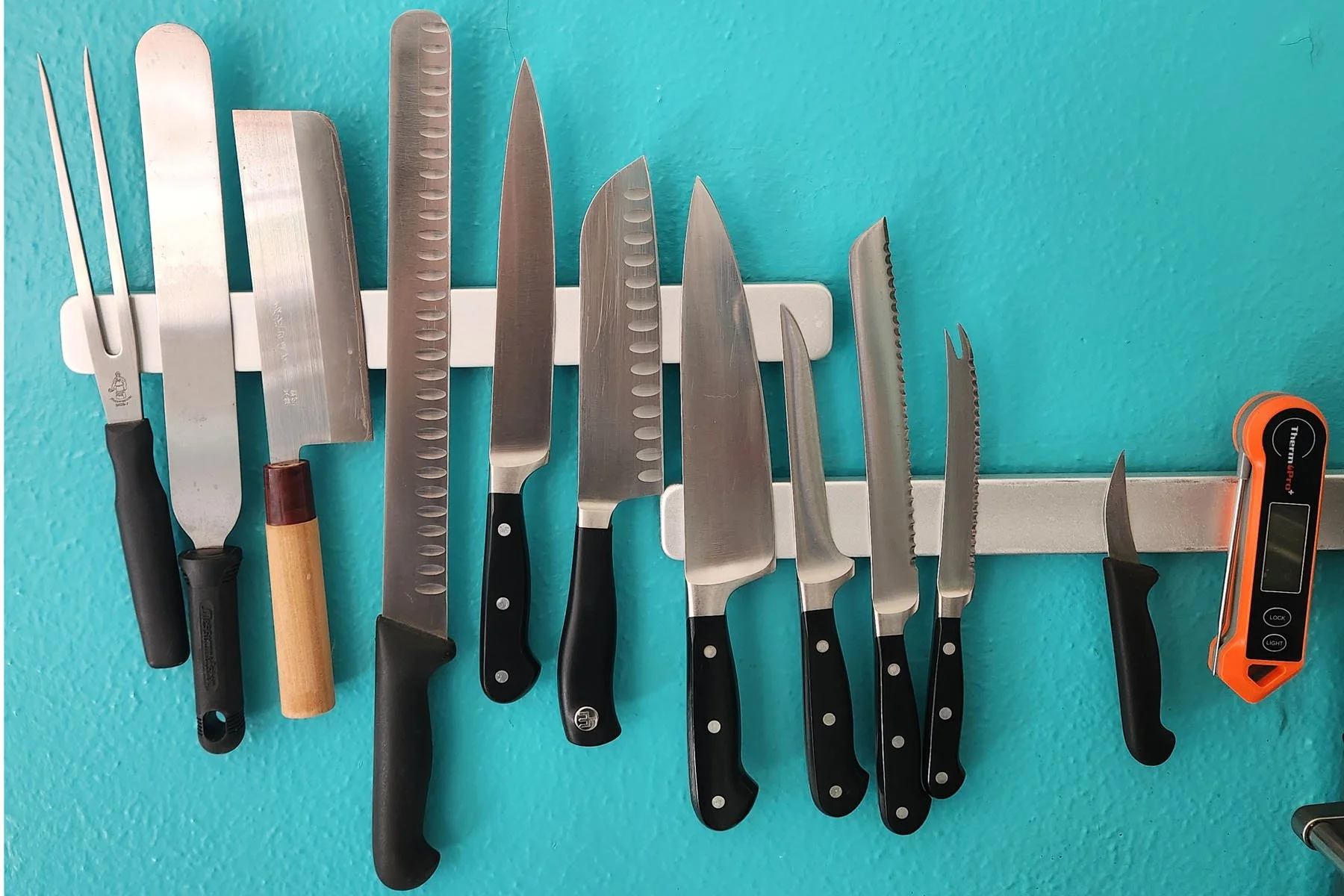
The Power of Magnets: I lean heavily into magnets to save my counters. I installed a magnetic spice rack at the top of the basement stairs so I can see my culinary spices at a glance. I also hung magnetic knife strips near the stove. While you really only need a chef, bread, and paring knife, the strips let me keep my "extras" (like my favorite tomato knife) out of the way but ready to work.
Fridge Greenery: To keep the space feeling happy, I added magnetic shelves to the side of my fridge for plants. I originally tried herbs, but realized we weren't a good match (too much watering!). Now, it’s a beautiful display of propagated plants that I get to look at while I eat breakfast.
Inside the Doors: I use the "dead space" inside cabinet doors for storage. Command hooks hold my silicone reheating lids, and a pot-lid holder keeps my Snapware lids organized. It’s a simple way to end the avalanche of Tupperware that can happen in a small cupboard.
Wall Storage: My cooking spoons, spatulas, and tongs live on the wall behind the stove in a hook-and-cup setup. It keeps them right where they are needed without a utensil carafe blocking valuable counterspace.

Using Canning Jars for Flexible Food Storage
If there is one workhorse in my kitchen, it’s the canning jar. I default to wide-mouth jars as often as possible so the lids are interchangeable. They are less expensive than standard food storage sets and infinitely more versatile.
Freezer Bank: I use pint jars to freeze single servings of soup or home-cooked beans (one jar = one store-bought can). I use ½-cup jars for bulk-grated parmesan and 1-cup jars for sauces, dips, or extra buttermilk that I want to save for future baking. (I will write more on my love of freezing for making meals easier soon!)
Pantry & Beyond: Quart jars are perfect for granola, rice, growing sprouts, or freezing homemade stock (one jar = 1 box of stock).
Lid Strategy: I use a mix of classic metal rings and plastic lids, though I am slowly shifting toward plastic (or plastic with silicone linings). Metal rings tend to rust over time, especially when they are constantly moving in and out of the fridge and freezer. I also have specific tops for different tasks, like screen tops for growing sprouts or straw-hole lids for drinks. I keep all these interchangeable lids in one small bin tucked inside the larger bin where the jars live. It is bin inception! It is storage for storage!
You Can Meal Plan for the Kitchen You Have
You don’t need a Pinterest-perfect kitchen or a massive pantry to have a functional meal planning (and prepping) rhythm. You just need to reduce the friction. By corralling the chaos into bins, utilizing your vertical wall space, and leaning into versatile tools like canning jars, you can make even the smallest kitchen feel like a place of possibility.
If I can develop a thousand recipes without a dishwasher or a pantry, I promise you can find a rhythm that works for you, too. Don’t want to do it alone? Join us in Meal Planning Collective for virtual community support and inspiration that is realistic, satisfying, and nourishing.
-
As a professional recipe developer, I’ve created over 1,000 recipes in a small kitchen with no dishwasher and no pantry.
Successful meal planning (and cooking) isn't about having a perfect space; it’s about reducing the friction in the space you have.
My goal is to help you feel more confident in your kitchen so cooking becomes a pleasure, not a chore.
-
In my experience, it’s Decision Fatigue.
When your kitchen is cluttered or you always rely on new recipes, your brain has to work too hard before you even turn on the stove.
Remove the micro-stressors of searching for ingredients in a chaotic cupboard or feeling like your meals need Michelin star approval to be good enough.
You can make your meal plan and your kitchen real-life ready, leaving you more mental energy to enjoy your food (and the process).
-
My nutrition philosophy is right in the name, Whole You. That means we look at the big picture.
We don't just talk about nutrients; we talk about your environment, your energy levels, and your favorite foods.
Whether through one-on-one sessions or in the Collective, I help you bridge the gap between knowing what is healthy and getting a realistic and satisfying meal on the table on Tuesday night.
The information provided is for educational and informational purposes only. It is not intended to be medical advice or to diagnosis, treat, cure or prevent any disease. This information does not replace a one-on-one relationship with a physician or healthcare professional. Dietary changes and/or the taking of nutritional supplements may have differing effects on individuals.
To learn more about how working with a nutritionist could help you, schedule a free 15-minute call.